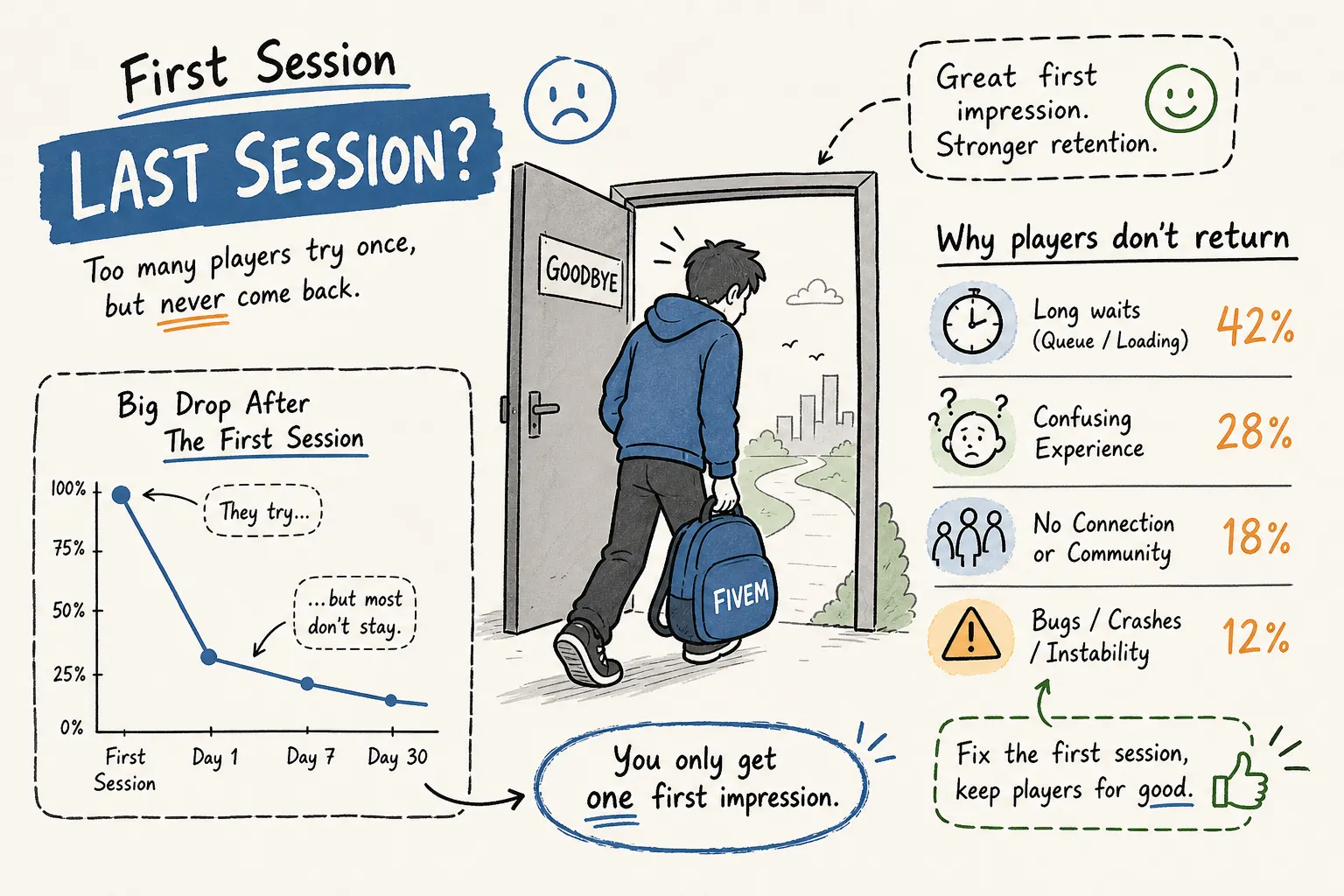
Players join, explore for 20 minutes, and never come back. You check the player list the next evening and see zero familiar names. That is not bad luck, that is a broken first-session experience, and it is common across many servers regardless of how much content they have.
Short answer: FiveM players do not come back after their first session because of technical dropout (instancing errors, crashes), a spawn moment with no direction, and no onboarding flow. Fixing OneSync configuration, hosting specs, spawn design, and a guided first job in that order stops most first-session churn. This article walks through each failure point and gives you a concrete fix for every stage.
The first session is not a play session. It is a conversion event. Either you earn a return visit, or you lose that player permanently.
How to Stop Players From Leaving After the First Session
First-session departures are almost always misdiagnosed. Operators assume players left because the server was quiet or the content was not interesting enough. In most cases, something broke before the player ever had a chance to form an opinion about the experience.
There are two distinct categories of dropout, and mixing them up wastes time and money. The first is technical dropout: players who left because something failed at the infrastructure level, disconnects, kicks, instancing errors, lag spikes. The second is experience dropout: players who stayed connected but had no reason to keep playing. Both categories kill retention, but they require completely different fixes.
Why instancing is a symptom, not the cause
Strict NAT forces players into a solo lobby, making your server feel completely dead. When a new player spawns and sees nobody around them, they assume the server is empty and leave without saying a word. What they experienced was not an empty server, it was a peer-to-peer connectivity failure caused by packet loss, unstable routing, or their own NAT type. They have no way to know the difference, and they do not care. They just leave.
Operator reports across community forums consistently point to a meaningful share of players experiencing solo session errors on joining, requiring multiple connection attempts before landing in the correct lobby. That friction alone accounts for a significant slice of first-session departures before the player even sees your content. Community threads discussing instanced session issues on the Cfx.re forums are a useful place to learn typical failure patterns and user-reported fixes.
How server crashes look like "everyone left"
Memory leaks, CPU bottlenecks, and poorly optimized scripts produce mass disconnects that players interpret as a dead server. A player who gets kicked twice in 20 minutes does not file a bug report, they leave and find another server. These events rarely surface in your logs as retention problems because there is no automatic correlation between disconnect spikes and returning player data. Without monitoring that tracks when mass kick events overlap with login gaps in subsequent sessions, the connection stays invisible.
The Spawn Experience Problem Owners Almost Always Overlook
The spawn moment is when a new player forms their first impression of your server. Many operators have not consciously designed this moment at all. It just happens, and it is usually broken in ways they have stopped noticing because they have seen it a hundred times.
The first minutes decide everything
A new player spawning with no direction, no welcome, and no visible activity will leave within minutes. A well-designed spawn moment looks like this: an automated in-game welcome that fires immediately, a clear next step for the player to follow, and at least one visual cue that the server is populated and active. Contrast that with the typical experience of dropping into a random map location with an empty chat window and no indication of where to go or what to do first.
Character creation friction and the empty lobby feeling
Complex character creation menus, unclear UI prompts, and the absence of other players in the spawn area combine to make a server feel abandoned. Players entering an unfamiliar system with generic "Press E" prompts and no lore context feel like they are clicking through a tutorial nobody finished building. Replacing generic interaction prompts with a targeting system like QB Target and streamlining character creation into a lore-friendly sequence can meaningfully change how a new player feels during their first five minutes.
Technical Fixes to Stop Players Leaving
These configuration and infrastructure changes directly prevent technical dropout. They are not glamorous, but they are the fastest way to stop losing players before they even experience your content. For a broader walkthrough, see our FiveM server.cfg performance checklist.
Server.cfg settings that prevent mass disconnects
Three configuration changes deliver the highest impact for stability. Enable sv_oneSync infinity. It is the only mode that fully syncs all entities to all players and removes the 32-player hard cap that causes instancing at scale. Set sv_maxclients a few slots below your actual target, if you are running a 48-slot server, cap it at 44. This prevents overload during peak join periods where multiple players connect simultaneously and spike the server load. Enable sv_endpointprivacy true to block player IP exposure from scripts, a common vector for social engineering attacks that trigger mass disconnects.
OneSync Infinity also requires explicit activation in your startup command with +set onesync on, not just in the config file. Some hosting environments do not apply the config-only version correctly, which means players hitting 33-plus slots experience instancing bugs that look like random kicks.
Hosting specs and network choices that match your player count
FiveM's performance depends almost entirely on single-core CPU clock speed, not core count. A high clock-speed processor running one thread fast outperforms a many-core server for FiveM workloads, producing fewer script timeouts under comparable load conditions. Pair that with NVMe SSD storage and fast RAM, particularly for database-heavy frameworks like economy and vehicle persistence, and your server's baseline stability improves measurably. Your datacenter location should sit geographically close to where most of your players connect from.
Free or low-end hosting significantly increases your churn risk regardless of how good your scripts are. Shared resources, HDD storage, and absent DDoS protection mean your server is unstable by default. Game-layer DDoS protection is not optional for FiveM servers, they are frequent targets, and running without mitigation produces the kind of random disconnects that players blame on the server and never investigate further. Community-driven hosting recommendations on Cfx.re are a useful reference point.
Resource limits and script management that keep the server stable
Keep active resources under 150 for a stable 32-player environment. Beyond that number, CPU thread contention increases and script timeouts become a regular occurrence. Citizen.Wait(0) loops in scripts spike CPU usage continuously rather than in bursts. A single poorly written resource running a tight loop can consume enough single-thread capacity to produce lag spikes that feel like crashes to every connected player. Run the FiveM profiler during your busiest hour and fix the top resource drains first. Database queries without caching are the other major cause: every time a query hits the database directly instead of a cached result, it introduces a latency spike that the player experiences as a freeze or disconnect.
The Onboarding Changes That Make Players Want to Come Back
Technical stability gets players through the door. Onboarding is what makes them return the next day. Most FiveM servers have content but no designed journey through that content for a first-time player. They have scripts, they have jobs, they have a map, but no sequence that guides a newcomer from spawn to their first anchor in the community. For actionable tactics on converting first-time visitors into returning players, see how to advertise a FiveM server.
A guided first-interaction flow that replaces wandering
A structured onboarding sequence starts with an automated welcome that transitions directly into a lore-friendly RP moment, not a static menu or a wall of text. From there, the player follows a guided path to the first job or activity and encounters either a staff member or an experienced community member early in that journey. The goal is to eliminate the wander-and-quit pattern where new players explore aimlessly, find nothing to anchor to, and leave within 15 minutes having formed no connection to the community. An immediate objective, even a simple one like "get your ID" or "find your first job", gives players forward momentum instead of paralysis.
Job availability as an immediate first step
New players who cannot find a working job in the first session are much less likely to return for a second one. The most effective starter economy configurations offer multiple viable entry-level activities that require no existing relationships, no gear, and no license. A centralized job center at city hall or a dedicated location gives new players an immediate answer to "where do I go first" without requiring them to ask in chat. If your server has a single functional starter job, or a broken one, new players are gone before they ever discover the parts of the server worth staying for.
Discord structure and response time as retention levers
A player who joins your Discord and sees no response to their question within 24 hours treats that silence as a preview of how the entire server operates. Clear channel categories, a functional ticket system, and defined staff roles that separate rule enforcement from player support signal to new players that this community is active and organized. The first five minutes in your Discord influence whether a player ever loads the game client. If they see dozens of unlabeled channels with no context, they leave before they ever connect. Whitelist applications should be short, approvals should happen within 24 to 48 hours, and every rejected application should include enough feedback that the player understands why.
Turning a One-Time Visit Into a Loyal Community Member
Fixing each individual stage helps, but the servers with the best long-term retention treat the first session as one piece of a designed system. A server that grows consistently is one where the operator has a roadmap for the player journey, not just a collection of scripts assembled over time.
Weekly events, ongoing server storylines, and mentorship programs for new players give people a reason to come back when they have no personal objective queued up. A player with something to work toward logs in tomorrow. A player who finished their session with nothing waiting on the other side does not. Fixing your stability problems first creates the bandwidth to actually build this layer, which is why technical fixes always come before retention strategy.
Fix the Foundation, Keep the Players
Players do not come back because the first session was never designed to make them want to. Technical failures, a broken spawn, no onboarding sequence, and nothing pulling them back for day two are each solvable problems on their own. If your server is already declining, see how to revive a dying FiveM server for a step-by-step recovery roadmap. The operators who actually stop the churn are the ones who address all four together, in the right order, with fixes that build on each other.
Cutting first-session churn is not about adding more content or running bigger events. It is about getting the foundation right so that every new player who joins has a reason to stay and a clear reason to come back tomorrow. More scripts on top of a broken base do not help, they add complexity to a system that is already failing the people it is supposed to serve. If you want a custom roadmap that addresses your specific setup, framework, and player base, start with a server audit at FiveM Coach.